If you've been following the AI space in 2026, you've heard "AI agent" thrown around constantly. But what actually is one — and how is it different from the chatbot your company already has?
This guide explains AI agents in plain English: what they are, how they work, what makes them powerful, and where they fall short.
What Is an AI Agent?
An AI agent is a software system that can perceive its environment, make decisions, and take actions autonomously to achieve a defined goal — often without a human directing each step.
The word "agent" comes from the Latin agere, meaning "to do". That's exactly what separates an agent from a regular AI: it doesn't just respond to a question, it goes out and does something.
Here's the simplest version:
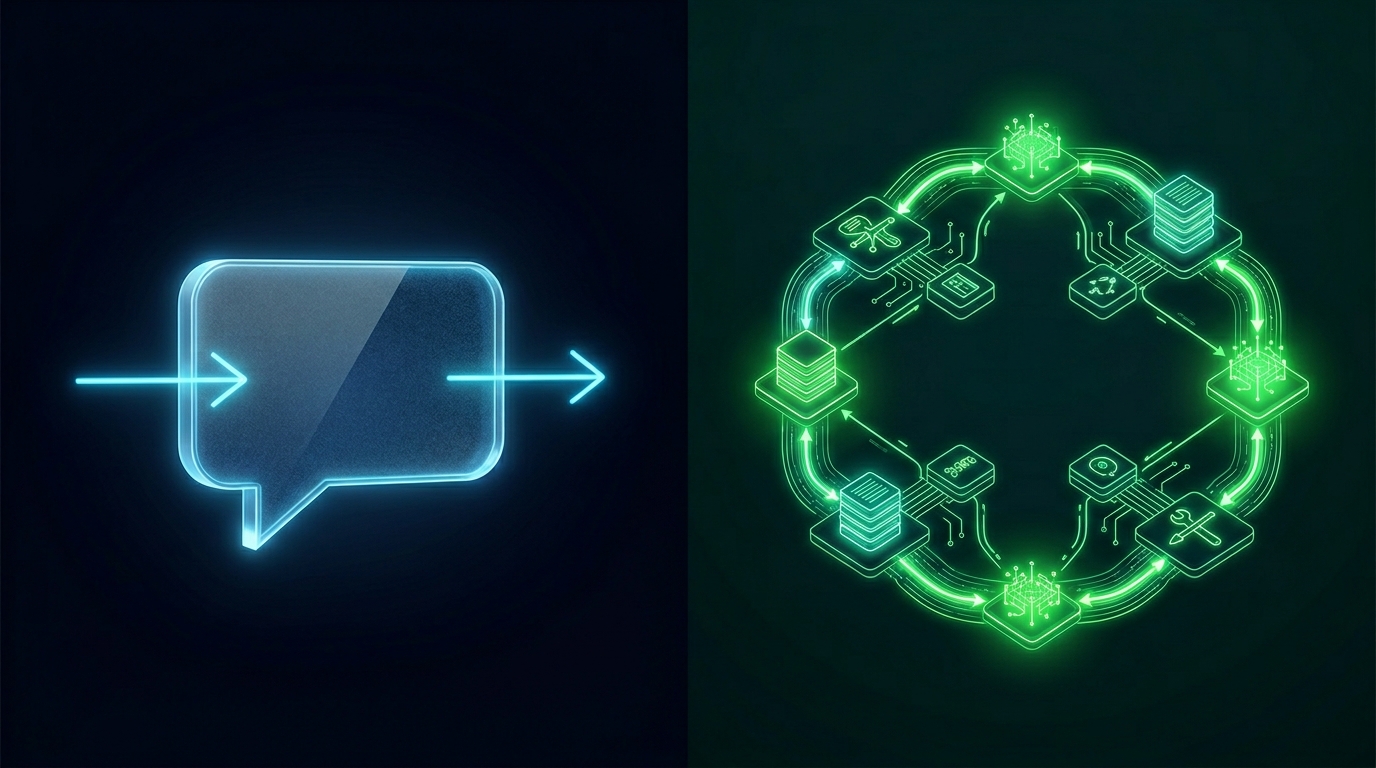
A chatbot answers your questions. An AI agent completes your tasks.
A chatbot tells you "here's how to send that email". An AI agent drafts the email, checks your calendar for context, and sends it — all on its own.
The Four Components of an AI Agent
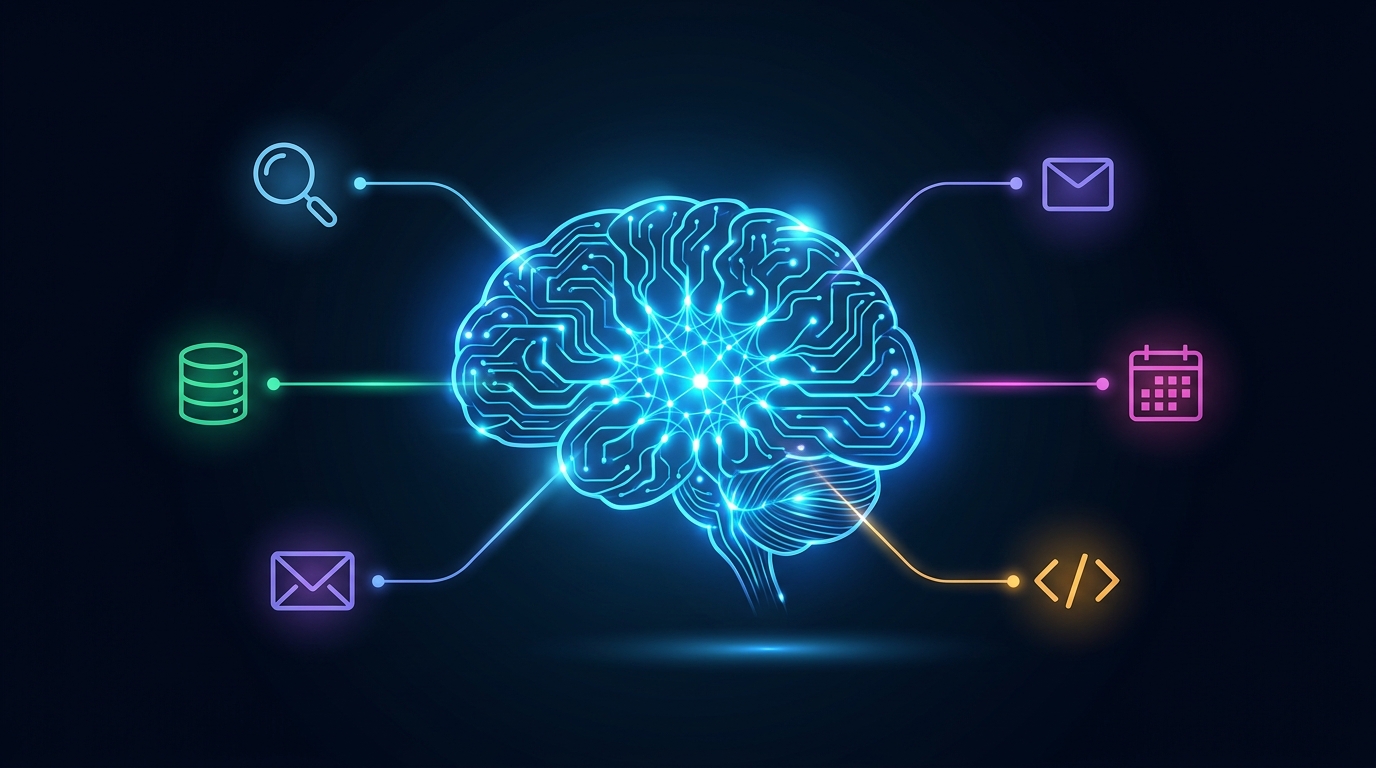
Every AI agent, regardless of complexity, is built from four core parts:
1. The Brain (Large Language Model)
The LLM — Claude, GPT-4o, Gemini — is what does the reasoning. It reads the context, interprets the goal, and decides what to do next. Without a capable LLM at the core, the agent can't think.
2. Tools (How It Acts on the World)
Tools are what give an agent hands. These can be: - Web search - Code execution - Database queries - API calls (CRM, email, Slack, calendar) - File read/write - Browser control
The agent calls these tools when it needs to gather information or take an action. An LLM alone can only generate text. With tools, it can do things.
3. Memory
Agents need to remember context across steps. There are two types: - Short-term (working memory): The current conversation or task thread — what has been done, what was found, what comes next. - Long-term memory: A persistent store (vector database or structured store) that lets the agent recall information across separate sessions.
4. Orchestration (The Loop)
This is what makes an agent an agent. The orchestration layer runs a continuous loop: 1. Observe the current state 2. Decide on an action 3. Call a tool 4. Observe the result 5. Repeat until the goal is reached
This loop — often called the ReAct pattern (Reason + Act) — is what allows agents to handle multi-step tasks that a single LLM call cannot.
AI Agent vs Chatbot: What's the Difference?
This is the most common question. Here's the honest breakdown:
Chatbots are question-and-answer systems. They accept one input, generate one output, and stop. They can be powered by LLMs (like a customer service bot), but they don't take actions in the world beyond the conversation itself.
AI agents are goal-completion systems. You give them an objective, and they figure out the steps, use tools, check their own work, and iterate — often without you staying in the loop.
The difference is like giving directions vs hiring a driver. The chatbot tells you how to get there. The agent gets you there.
Types of AI Agents
Not all agents are the same. Here's how they're typically classified:
Single-Step Agents
Do one thing with tools — search the web, query a database, write a file. Simple but useful for automating repetitive lookups or data fetching.
ReAct Agents (Reason + Act)
The most common type. The agent reasons about what to do, calls a tool, observes the result, reasons again, calls another tool — until the task is done. This is the foundation of most production agents in 2026.
Multi-Agent Systems
Multiple agents working in parallel or in a pipeline, each specialised for a subtask. A "planner" agent breaks down a goal, "worker" agents execute sub-tasks, a "reviewer" agent checks the output. More powerful, but more complex to build and debug.
Autonomous / Long-Running Agents
Agents that run on a schedule or in the background — monitoring a system, processing a queue, or responding to events — without being triggered by a human prompt each time.
What Can AI Agents Actually Do?
Here are real-world examples that Singapore and global businesses are deploying right now:
Operations - Automatically triage and respond to support tickets, escalating only what needs a human - Monitor inventory and place purchase orders when stock drops below threshold - Extract data from invoices and populate accounting systems
Sales & Marketing - Research leads, find contact details, draft personalised outreach, and log to CRM - Monitor competitor pricing and update internal pricing documents - Generate and schedule social media posts with SEO-optimised captions
Software Development - Scan a codebase for bugs, write fixes, and open pull requests - Run test suites, interpret failures, and attempt fixes automatically - Generate documentation from code comments and deploy to a docs site
Finance & Legal - Review contracts for specific clauses and flag anomalies - Reconcile transactions against bank statements - Summarise regulatory updates relevant to your industry
Why Are AI Agents Getting So Much Attention in 2026?
Three things converged at once:
1. LLMs got good enough. Claude 3.5/4, GPT-4o, and Gemini 1.5 Pro are reliable enough to reason through complex multi-step tasks without hallucinating at every turn.
2. Tool-calling became standardised. The Model Context Protocol (MCP), introduced by Anthropic in late 2024, created a common interface for connecting LLMs to any tool or data source. Before MCP, every agent was a custom integration nightmare.
3. Framework maturity. LangGraph, AutoGen, and the Claude Agent SDK now give developers solid primitives for building production-grade agents — with memory, state management, error handling, and observability built in.
The result: what took 6 months to prototype in 2023 can be built and deployed in 2–4 weeks today.
What AI Agents Can't Do (Yet)
Being honest matters here. Agents are powerful, but they have real limits in 2026:
- They still make mistakes. On complex reasoning chains, LLMs can go off-course. Production agents need guardrails, validation steps, and human-in-the-loop checkpoints for high-stakes decisions.
- They're not magic automation. Building a good agent requires proper tool design, prompt engineering, error handling, and testing — the same rigour as any software project.
- Long-running reliability is still maturing. Agents that run for hours across dozens of steps are more prone to drift. Most production deployments break complex tasks into shorter, verifiable segments.
- Cost scales with token usage. Agents that call the LLM many times per task can get expensive at scale. Optimising the reasoning loop matters.
How to Get Started with AI Agents
If you're a developer, start here: - How to Build an AI Agent (Step-by-Step, 2026) — a practical tutorial covering tools, memory, and the orchestration loop - Best AI Agent Frameworks Compared: LangGraph vs AutoGen vs Claude SDK — which framework to choose and why - MCP Server Tutorial — Build Your First Model Context Protocol Server
If you're a business evaluating AI agents: - 15 AI Agent Use Cases for Singapore Businesses — real examples by industry - AI Agent vs Chatbot — What's the Difference? — if you already have a chatbot and wonder if you need an agent
Building an AI Agent for Your Business
Not every business needs to build its own agent from scratch. The question to ask: does your company have repetitive multi-step workflows that currently need a human to coordinate? If yes, an agent is likely a good fit.
At Power Digital, we build custom AI agents for Singapore businesses — from lead qualification agents to operations automation to code-generation pipelines. We work with LangGraph, the Claude API, and MCP to deliver agents that run reliably in production.
Talk to us about AI agent development →
Power Digital is a Singapore-based AI agent development and web app studio. We've been building digital products since 2014.