
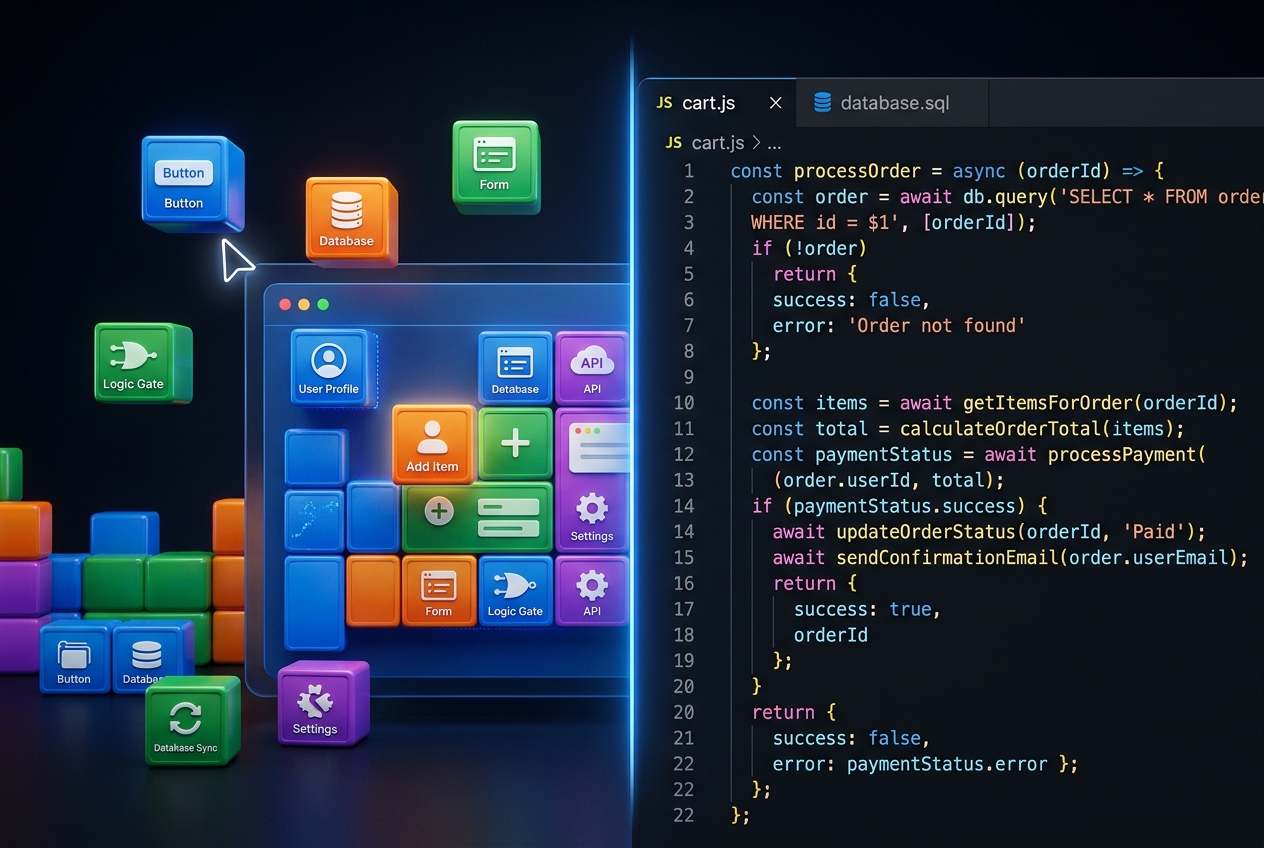
No-Code vs Custom Development — When to Use Which (2026)
No-code tools have matured dramatically. Bubble, Webflow, Glide, and a dozen others can now build products that would have required a full engineering team three years ago. But "no-code can build anything" and "no-code is right for your situation" are different statements.
This guide gives you a practical decision framework — not a philosophical one — for choosing between no-code and custom development.
The Core Distinction
No-code means building on someone else's infrastructure, within someone else's constraints, in exchange for speed and lower initial cost.
Custom development means owning every layer of your product — the architecture, the logic, the data — in exchange for time and money.
Neither is universally better. The right choice depends on where you are, what you're building, and how much optionality you need in six months.
When No-Code Wins
1. You need to validate before you build
If you haven't yet proven that users will pay for your product or use it consistently, build on no-code first. The cost of building a custom app for a hypothesis that turns out to be wrong is enormous. The cost of validating on Bubble or Glide and then rebuilding is much lower.
Typical validation timeline with no-code: 2–4 weeks. Typical validation timeline with custom: 8–16 weeks. If you can get evidence of demand in 4 weeks instead of 16, that's 12 weeks of runway saved.
2. Your product fits the template
No-code platforms excel at specific product categories: marketplaces, directories, booking systems, CRM-adjacent tools, content portals, community platforms, and simple SaaS dashboards. If your product looks like one of these, no-code is likely a reasonable long-term choice — not just a validation step.
Strong no-code fits: - B2B internal tools (Retool or Notion-based systems) - Membership sites with content and basic user management - Directory or marketplace MVPs - Simple booking/scheduling apps - Content-heavy portals with user authentication
3. You have a non-technical team and no plans to hire engineers
If your team has no developers and you're not planning to hire any in the next 12 months, custom development creates a dependency on an external agency for every change. No-code puts more control in your hands — a business-minded team member can often make content and logic changes without an agency.
4. Budget is the primary constraint
A no-code MVP can be built for S$5,000–S$15,000 (design + no-code configuration + setup). The same product in custom development costs S$20,000–S$60,000. If you're pre-revenue and bootstrapped, the no-code approach preserves runway.
When Custom Development Wins
1. Your product has a technical moat
If the reason your product is better than alternatives is how it works — your algorithm, your data pipeline, your integration architecture, your AI model — you cannot build that moat on top of someone else's platform. No-code abstracts away the logic layer, which is fine for commodity features but fatal for differentiated ones.
Examples of products that need custom: ML-based recommendation systems, high-frequency trading tools, anything with a proprietary data model, AI agents, complex B2B workflow automation.
2. You have regulatory or data requirements
PDPA compliance in Singapore requires specific data handling practices. Financial applications fall under MAS guidelines. Healthcare applications have their own data residency and audit trail requirements. No-code platforms give you limited control over where data is stored, how it's processed, and what audit logs are generated.
If your product will handle sensitive personal data, payment data, health data, or government-linked data, custom development is almost always the right choice — the compliance risk of building on a third-party no-code platform is too high.
3. You need performance at scale
No-code platforms share infrastructure. At low user volumes, this is fine. At high volumes (tens of thousands of daily active users, real-time features, complex queries), shared infrastructure creates performance ceilings you can't design around. Custom development lets you optimise the stack for your specific load pattern.
4. You're building a long-term platform, not an MVP
If your 3-year vision is a large, complex product with multiple user types, deep integrations, and a team of developers, starting on no-code creates technical debt you'll pay to migrate off later. The migration from Bubble to custom code at 10,000 users is painful. Starting custom at the right scale is sometimes the less expensive path over 3 years even if it's more expensive in year one.
5. You need mobile parity
Most no-code tools are web-first. Bubble doesn't produce iOS or Android apps — it produces a web app that runs in a browser. For products that genuinely need a native mobile app (push notifications, device sensors, background processing, offline mode), you'll need custom development regardless of what the no-code tool's marketing says.
Flutter wraps a no-code workflow? No. Custom code produces the Flutter app.
The Hybrid Path
The most pragmatic approach for early-stage Singapore startups in 2026:
- Validate on no-code (Webflow + Airtable + Zapier, or Bubble) for 4–12 weeks
- Raise or generate revenue using the no-code product
- Rebuild on custom once you have evidence of demand and funding to execute properly
This path front-loads validation and back-loads the infrastructure investment. The rebuild is real work, but it's less risky than building custom before you know what you're building.
No-Code Platform Quick Reference (2026)
| Platform | Best For | Singapore Usage |
|---|---|---|
| Webflow | Marketing sites, content portals | High — excellent for agency sites and landing pages |
| Bubble | Web apps with logic (SaaS, marketplaces) | Moderate — growing startup adoption |
| Glide | Mobile-first internal tools | Low — niche use cases |
| Retool | Internal admin tools and dashboards | Growing in enterprise |
| Notion | Documentation and simple databases | Very high — almost ubiquitous |
| Airtable | Database-first tools and CRMs | High — popular with ops teams |
| Framer | Animated marketing sites | Growing among design-led teams |
The Decision Framework
Ask these questions in order:
- Is this for validation? → Start no-code unless you have strong prior evidence.
- Is there a technical moat in how it works? → Custom required.
- Will it handle regulated data? → Custom strongly preferred.
- Do you need native mobile apps? → Custom required.
- Will you have developers on the team within 12 months? → Consider custom for long-term cost efficiency.
- Is budget the primary constraint and timeline flexible? → No-code.
If you've answered "no-code" but you're building a product with a 3-year roadmap that includes any of the custom-required items above, plan the migration from the start — it's not a pivot, it's an upgrade, and it's planned for when you can afford it.
What PowerDigital Does
We build custom products. But we also tell clients when no-code is the right choice — because shipping the wrong thing on custom code is not in anyone's interest.
If you're mid-validation and wondering whether to rebuild, or if you're starting from zero and trying to choose, book a 30-minute scoping call with us. We'll tell you honestly what approach fits your situation.