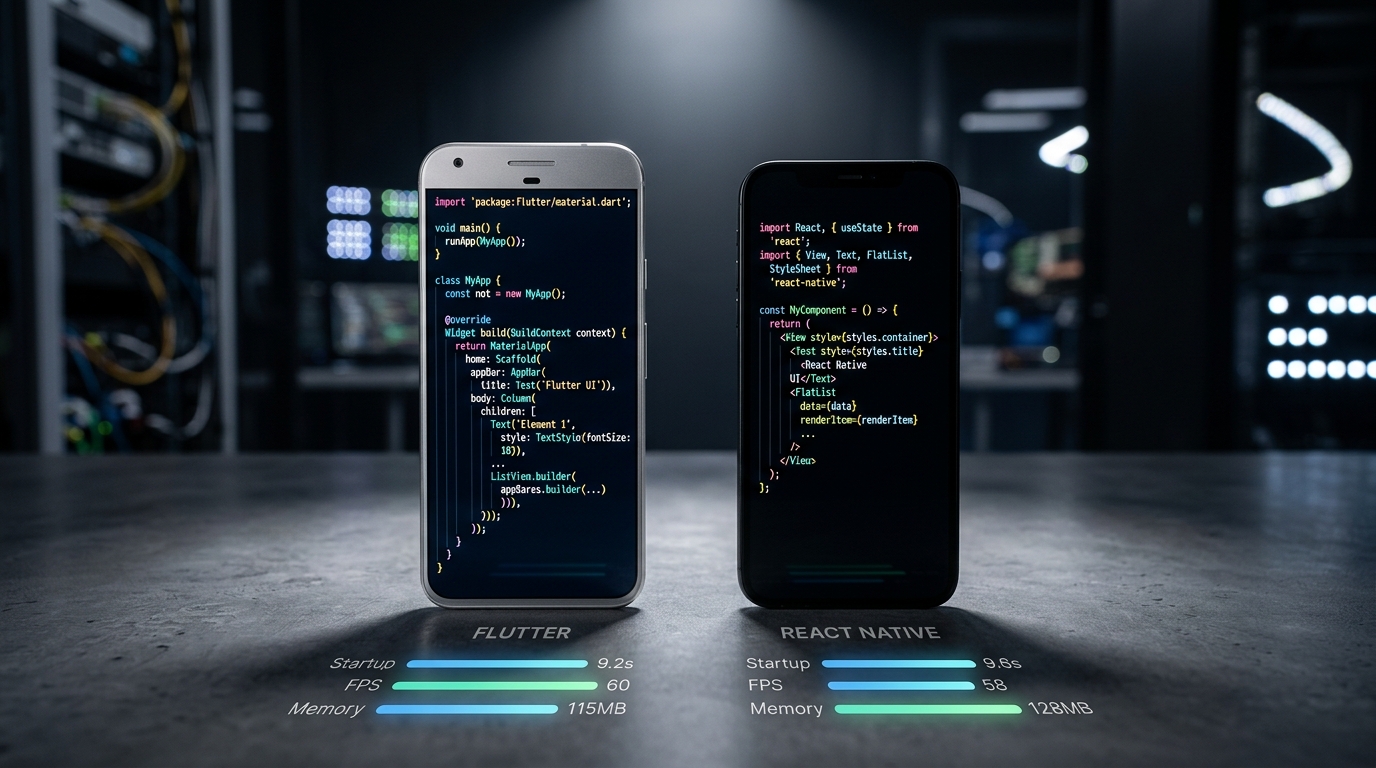
Flutter or React Native — this is the most common question when starting a mobile app project in 2026. Both are mature, production-proven cross-platform frameworks. The difference is in philosophy, performance characteristics, and ecosystem. Here is an honest comparison.
The Core Difference
Flutter brings its own rendering engine (Skia/Impeller). It does not use native UI components — it draws every pixel itself. This means pixel-perfect consistency across iOS, Android, and web, but also means your app looks the same on every platform rather than looking native to each one.
React Native bridges to native UI components. A button in React Native uses the actual iOS UIButton or Android Button under the hood. The app feels more native to each platform but the bridge architecture introduces some performance overhead and platform-specific behaviour to manage.
Performance
Flutter wins on animation and render performance. The Impeller rendering engine (default since Flutter 3.10) eliminates shader compilation jank that affected earlier versions. For UI-heavy apps with custom animations, Flutter is noticeably smoother.
React Native's New Architecture (Fabric + TurboModules, fully stable since RN 0.73) significantly closed the gap. For most business apps that are primarily data display and forms rather than complex animations, the performance difference is negligible in practice.
Developer Experience
Flutter/Dart: Dart is a strongly-typed language that is easy to learn if you know any C-style language. Hot reload is excellent. The Flutter SDK includes everything you need — no hunting for compatible libraries for common tasks. Downside: Dart is not used elsewhere, so your developers are not bringing transferable skills from other domains.
React Native/JavaScript or TypeScript: React developers can pick up React Native quickly. Huge ecosystem of JavaScript packages. TypeScript support is first-class. Downside: JavaScript's looser type system means more runtime errors unless you use TypeScript strictly, and the library ecosystem is fragmented with compatibility issues between packages.
Ecosystem and Packages
React Native's npm ecosystem is vastly larger than Flutter's pub.dev. But for mobile-specific packages (camera, maps, payments, push notifications), Flutter's ecosystem has matured significantly and covers all major use cases. The advantage React Native had in 2021 has largely diminished.
Web and Desktop Support
Flutter runs on iOS, Android, web, macOS, Windows, and Linux from a single codebase. React Native is primarily mobile — web support via React Native Web is usable but not the primary use case, and desktop support is less mature.
If your roadmap includes a web app alongside the mobile app, Flutter's single codebase story is genuinely compelling. See our guide on Flutter WASM for web apps.
When to Choose Flutter
- You want one codebase for iOS, Android, and web
- Your app has complex custom UI or animations
- Your team is starting fresh and can invest in Dart
- Pixel-perfect design consistency across platforms matters
When to Choose React Native
- Your team already knows React and JavaScript/TypeScript
- Your app needs to feel native to iOS and Android respectively
- You need access to a specific library that only exists in the npm ecosystem
- You are building a web app already in React and want to share code
The Honest Bottom Line
Both Flutter and React Native are excellent choices in 2026. The "best" one is the one your team can build and maintain most effectively. If you are starting fresh with no team preference: Flutter's performance story, single codebase for all platforms, and improving ecosystem make it the slightly stronger default in 2026. If your team knows React: React Native's productivity advantage from existing knowledge outweighs Flutter's technical edge.
Power Digital has shipped production apps in both Flutter and React Native. Talk to us about your mobile app project →