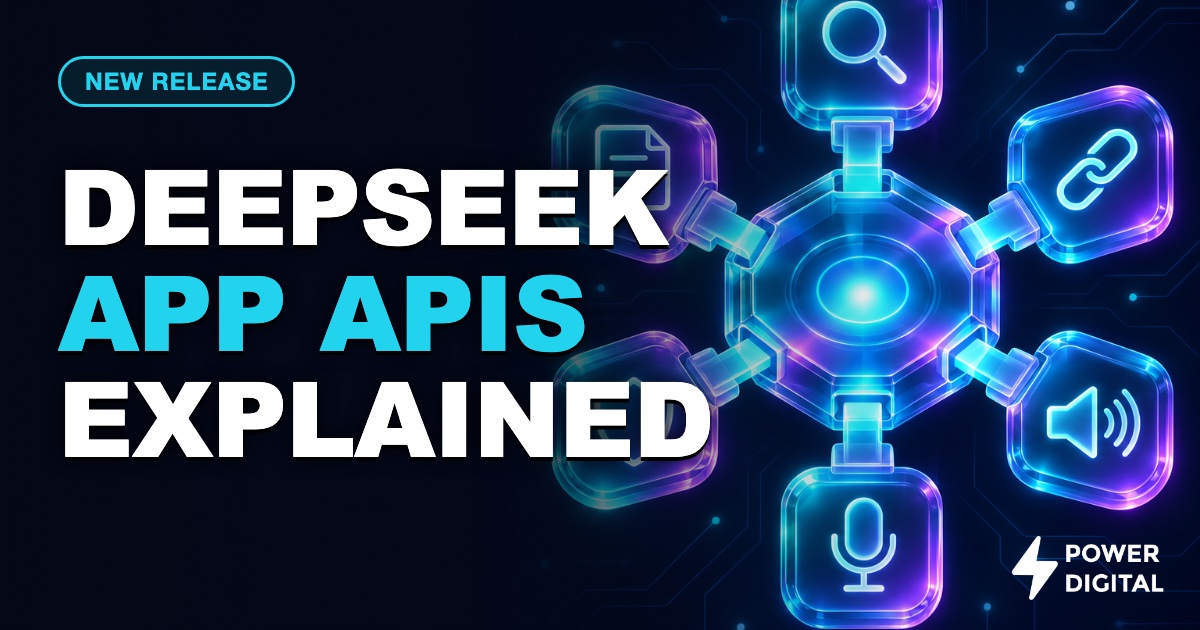
In short: On 13 November 2026 DeepSeek added web search, file reading, URL reading and safety checks to its deepseek-flash model, and released OCR, speech-to-text and text-to-speech as separate APIs. They are cheap, but DeepSeek's own policy says it stores data in China, so check the PDPA overseas-transfer rules before sending customer data.
What happened
DeepSeek's API update log lists a 13 November release of a suite of application APIs. Features are switched on by parameters in the existing Messages, Responses and Chat Completions APIs, and DeepSeek's service runs the tool calls.
Key details
- Web search (
deepseek_web_search): answers with citations, up to about 20 tool calls per answer when thinking is enabled. - File input: PDFs, Office files and images are parsed and added to context.
- URL reading (
deepseek_read_url): reads up to 10 distinct URLs from the last user message. - Safety check: reviews inputs and outputs and returns a refusal marker on risk. DeepSeek says public-facing services should enable it.
- Standalone APIs: Search and Fetch, OCR, ASR (speech to text) and TTS (text to speech).
OCR accepts files up to 100 MiB and 1,000 pages. ASR takes audio up to 120 seconds in 21 supported languages. TTS covers ten languages, including English, Mandarin, Malay, Thai and Vietnamese. DeepSeek has not announced Singapore availability.
Prices
The pricing page shows "$" without naming the currency; we treat it as USD and convert at 1 USD = 1.29 SGD (European Central Bank rates, 18 November 2026). Model prices are per 1M tokens, off-peak first. Peak hours are 01:00 to 04:00 and 06:00 to 10:00 UTC on weekdays, excluding Chinese public holidays.
| Item | USD | SGD |
|---|---|---|
| deepseek-flash input (cache miss), off-peak / peak | 0.15 / 0.30 | 0.19 / 0.39 |
| deepseek-flash output, off-peak / peak | 0.60 / 1.20 | 0.77 / 1.55 |
| deepseek-v4-pro input (cache miss), off-peak / peak | 0.66 / 1.32 | 0.85 / 1.70 |
| deepseek-v4-pro output, off-peak / peak | 1.98 / 3.96 | 2.55 / 5.11 |
| Search API or Fetch API, per 1,000 successful requests | 0.75 | 0.97 |
| File parsing and OCR, per 1,000 pages | 0.225 | 0.29 |
| TTS, per 10,000 characters (list / limited-time 50% off) | 0.45 / 0.225 | 0.58 / 0.29 |
| ASR, per hour of audio (list / limited-time 50% off) | 0.116 / 0.058 | 0.15 / 0.07 |
From 12:00 Beijing time on 18 November, search and fetch calls made inside a model call are not billed separately; returned results count as input tokens. The limited-time discount has no announced end date, and DeepSeek says prices may change. For scale, 10,000 OCR pages would cost about US$2.25 (S$2.90).
What it replaces in a typical agent build
In an AI agent these features can replace parts you would otherwise buy or code.
| New DeepSeek feature | What it usually replaces |
|---|---|
| Web search and URL reading parameters | A separate search provider, a page scraper and the code that feeds results to the model |
| File input and OCR API | A document parsing service for invoices, contracts and scanned forms |
| ASR | A speech-to-text vendor for voice notes and call clips |
| TTS | A voice vendor for spoken replies |
| Safety check parameter | Custom moderation before and after the model |
Our guide on what an AI agent is explains the parts.
What it means for businesses
These features often handle scanned IDs, invoices, recorded calls and chat text. Under section 26 of the PDPA, the Transfer Limitation Obligation, personal data may leave Singapore only if the recipient is bound by legally enforceable obligations giving comparable protection, per the PDPC's advisory guidelines (revised July 2017). Routes include law, a contract naming the permitted countries, binding corporate rules, or consent after a written summary of protections.
DeepSeek's privacy policy says it stores personal data in the People's Republic of China and lists model training as a purpose, with an opt-out by email. It does not cover end-user data from apps built on its platform; the developer must disclose its own policy. DeepSeek has not published retention periods for API data.
Questions to ask before sending customer data
- Which fields are personal data, and can you mask them first?
- Is there a contract with DeepSeek setting comparable protection? No such contract has been published.
- Is the data used for training, and is the opt-out confirmed in writing?
- How long are audio, text and files retained?
- Do your customer notices mention overseas transfer?
Our take
This is Power Digital's view. The prices are low enough to test on non-personal material such as public web pages and product manuals. For customer records, the missing retention and contract terms are the blocker until DeepSeek publishes them or signs an agreement. Keep the model layer swappable, as in our web application development work.