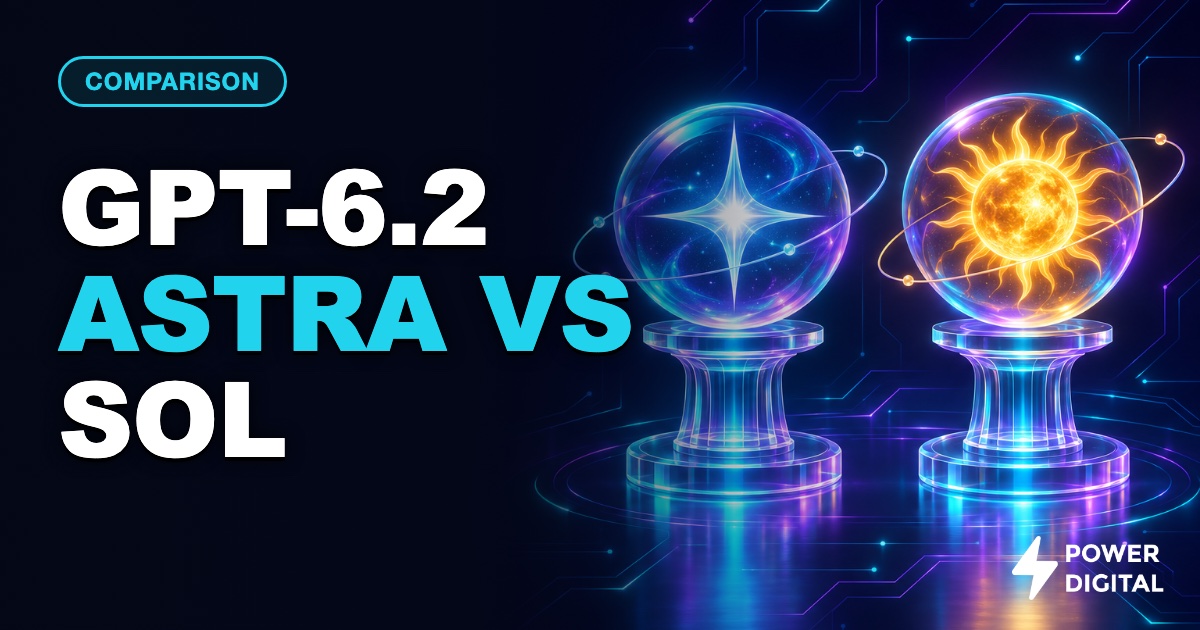
In short: OpenAI released GPT-6.2 Astra and GPT-6.2 Sol on 17 November 2026. Astra costs US$8 per million input tokens and Sol US$2, so Sol is a quarter of Astra's price per token, and the sensible default for most business agents is Sol until a task proves it needs more.
OpenAI announced the pair in a post for developers on its official developer community, and lists the rates on its API pricing page. Both models are in the API, ChatGPT Work and Codex. This article compares the two and works out what typical jobs would cost in Singapore dollars.
What happened
On 17 November 2026 OpenAI introduced two models. OpenAI positions GPT-6.2 Astra for its hardest projects and GPT-6.2 Sol as the cheaper, general-purpose option for daily tasks. OpenAI says Astra sets new highs on its evaluations for professional work and scientific research, at less than a third of the cost per task of GPT-6 Astra. On FrontierCode 2.0, which scores changes to real codebases that are ready to merge, OpenAI reports Sol coming close to Astra's result while costing roughly 20% as much.
OpenAI also calls Astra its strongest model yet for cybersecurity tasks, citing a 22-point gain over GPT-6 Astra on ExploitBench Internal Port, an internal test, and says both models launch with tighter safeguards for higher-risk cybersecurity requests. Approved defenders are expected to get access with fewer refusals through OpenAI's Daybreak programme, which OpenAI says it is still working on.
Key details
Availability
- ChatGPT Work and Codex: Plus, Pro, Enterprise and Edu users.
- API model IDs:
gpt-6.2-astraandgpt-6.2-sol. - Ultrafast speed: Pro 500 subscribers can use it with either model. Pro 200 subscribers get it for the first time, starting with Sol.
- Singapore: OpenAI has not announced Singapore-specific availability, pricing or data-centre location. Regional processing (data residency) endpoints carry a 10% uplift for models released after 5 March 2026.
Specs from the model pages
- Context window: 1,050,000 tokens for both. Maximum input 922,000 tokens, maximum output 128,000 tokens.
- Input: text and images. Output: text only. No audio or video. No fine-tuning.
- Knowledge cutoff: 18 May 2026 for Astra, 1 June 2026 for Sol.
- Supported in the Responses API: web search, file search, code interpreter, computer use and MCP.
- Requests that set reasoning effort to "none" are rejected.
Price per million tokens
Dollar prices are standard-tier API rates from OpenAI's pricing page. Singapore dollar figures use the European Central Bank reference rates published on 18 November 2026 (US$1 = EUR 0.9117, S$1 = EUR 0.7070, so US$1 = S$1.29). That was the latest rate published, and figures are rounded. OpenAI has not stated how GST is treated, so check your invoice.
| Model | Input (USD) | Input (SGD) | Output (USD) | Output (SGD) | Cached input (USD) | Cached input (SGD) |
|---|---|---|---|---|---|---|
| GPT-6.2 Astra | $8.00 | S$10.32 | $40.00 | S$51.58 | $0.40 | S$0.52 |
| GPT-6.2 Sol | $2.00 | S$2.58 | $10.00 | S$12.90 | $0.10 | S$0.13 |
| GPT-6 Astra (previous) | $10.00 | S$12.90 | $50.00 | S$64.48 | $1.00 | S$1.29 |
| GPT-6.1 Sol (previous) | $2.00 | S$2.58 | $10.00 | S$12.90 | $0.10 | S$0.13 |
Other pricing rules on the model pages: Batch costs 50% of standard rates. Fast mode costs twice standard. Ultrafast costs three times standard until 28 February 2027 and six times from 1 March 2027 (Pacific time). Requests with more than 272,000 input tokens double the input and cache rates, and output costs 1.5 times the short-context rate for the whole request.
How it compares
Astra against Sol
Per token, Sol is exactly one quarter of Astra on input, cached input and output. OpenAI's claim of about one-fifth the cost on FrontierCode 2.0 is a per-task figure, which depends on how many tokens each model spends on a task. Your own tasks may land differently, so measure on your own work.
Against the previous generation
GPT-6.2 Astra is cheaper per token than GPT-6 Astra: US$8 against US$10 on input and US$40 against US$50 on output, a 20% cut. GPT-6.2 Sol has the same list price as GPT-6.1 Sol (US$2 and US$10), so any saving there would have to come from the model needing fewer tokens, which OpenAI says.
Monthly cost for five common jobs
Volumes and token counts below are assumptions for illustration, so replace them with your own. Calculations use standard rates, no caching, no batch discount, and every request under 272,000 input tokens. Agents often make several model calls per task, so real bills will differ.
| Job | Assumed monthly volume | GPT-6.2 Astra per month | GPT-6.2 Sol per month |
|---|---|---|---|
| Customer-service chat agent | 5,000 x (3,000 in, 500 out) | $220.00 (S$284) | $55.00 (S$71) |
| Summarising long documents | 1,000 x (20,000 in, 1,000 out) | $200.00 (S$258) | $50.00 (S$64) |
| Drafting marketing copy | 300 x (1,000 in, 1,500 out) | $20.40 (S$26) | $5.10 (S$7) |
| Coding agent on a codebase | 200 x (150,000 in, 15,000 out) | $360.00 (S$464) | $90.00 (S$116) |
| Back-office agent with computer use | 2,000 x (40,000 in, 4,000 out) | $960.00 (S$1,238) | $240.00 (S$309) |
Because Sol is a quarter of the price per token, each row shows Astra costing four times as much for the same token volume. Even the heaviest example here is a few hundred Singapore dollars a month on Sol, so for most small and mid-sized businesses the model bill is smaller than the cost of building and supervising the agent. Our token cost calculator guide shows how to redo this with your own numbers.
What it means for businesses
Which one for which job
This table is Power Digital's view, reasoned from the prices and from OpenAI's own descriptions.
| Job | Start with | Why |
|---|---|---|
| Customer-service chat agent | Sol | High volume, short answers. Four times the token cost of Astra is hard to justify unless Sol visibly fails on your hardest questions. |
| Summarising long documents | Sol | Input dominates the bill. Try Sol first and have a person check a sample. |
| Drafting marketing copy | Sol | Volumes are small, so cost hardly matters. Choose by writing quality, which you judge by reading samples. |
| Coding agent on a real codebase | Sol, with Astra for the hard tickets | OpenAI reports Sol scoring close to Astra on a codebase test for about 20% of the cost. Send only the difficult changes to Astra. |
| Back-office agent using a computer | Astra for a pilot, then test Sol | Long multi-step runs punish mistakes, so begin with the stronger model, then see whether Sol holds up and cuts the bill. |
A short checklist before you switch
- Run 30 to 50 of your own real tasks through both models and score the results blind.
- Record tokens used per task, not just the price per token.
- Check where customer data is processed. If personal data leaves Singapore, your obligations under the PDPA still apply.
- Keep model names in a settings file so you can change models without rebuilding the agent.
- Set a monthly spend limit in the API account before launch.
If you want an agent built and tested this way, see our AI agent development service. If the agent sits inside a larger system, the same team builds web applications around it.
When the price rules change
Two rules can move a bill more than the headline rate. First, a request over 272,000 input tokens doubles the input rate for that whole request, so stuffing a very long document into every call is expensive even though the context window is 1,050,000 tokens. Second, Ultrafast triples the standard rate until 28 February 2027 and then sextuples it, so a speed upgrade that looks affordable now will cost twice as much from March 2027. Batch processing at half price suits overnight jobs such as report generation or data clean-up, where nobody is waiting for the answer.
Our take
This is Power Digital's opinion. The useful news is not a new top model but a cheaper everyday one with a very large context window. Most business agents answer routine questions, and for those a model priced at US$2 and US$10 per million tokens is already cheap enough that quality, safety and data handling matter more than the rate. We would default to Sol, keep Astra for the tasks where Sol is shown to fail, and treat every vendor benchmark here as a claim to test. We would also wait for independent results before relying on the cybersecurity or cost-per-task claims.
Sources
- OpenAI developer community announcement: release date, positioning, availability, cost claims, API prices.
- OpenAI API pricing page: standard, batch, Fast and Ultrafast rates, previous-generation prices, regional processing uplift.
- GPT-6.2 Astra model page: context window, output limit, cutoff date, supported tools.
- GPT-6.2 Sol model page: context window, output limit, cutoff date, supported tools.
- OpenAI news feed: title and date of the announcement.
- European Central Bank daily reference rates: USD and SGD rates for 18 November 2026.