Cross-platform app development lets you build once and deploy to iOS, Android, and the web from a single codebase. In 2026, the technology has matured to the point where cross-platform is the right default for most new mobile projects. Here is a practical guide to the frameworks, the trade-offs, and how to choose.
Why Cross-Platform Makes Sense Now
Building separate native apps for iOS (Swift/Objective-C) and Android (Kotlin/Java) means two codebases, two teams, twice the maintenance, and roughly twice the cost. In 2019, the performance and feature gaps between cross-platform and native were significant enough that high-performance apps stayed native. By 2026, those gaps have largely closed — and for most business applications, they do not matter.
The key caveat: "most business applications" means apps whose complexity is in business logic and data, not in platform-specific hardware access or cutting-edge OS features. Social media platforms, gaming, AR/VR — these still often benefit from native. An e-commerce app, a booking system, an operations dashboard, an internal tool — cross-platform is the right call.
The Three Main Options
Flutter
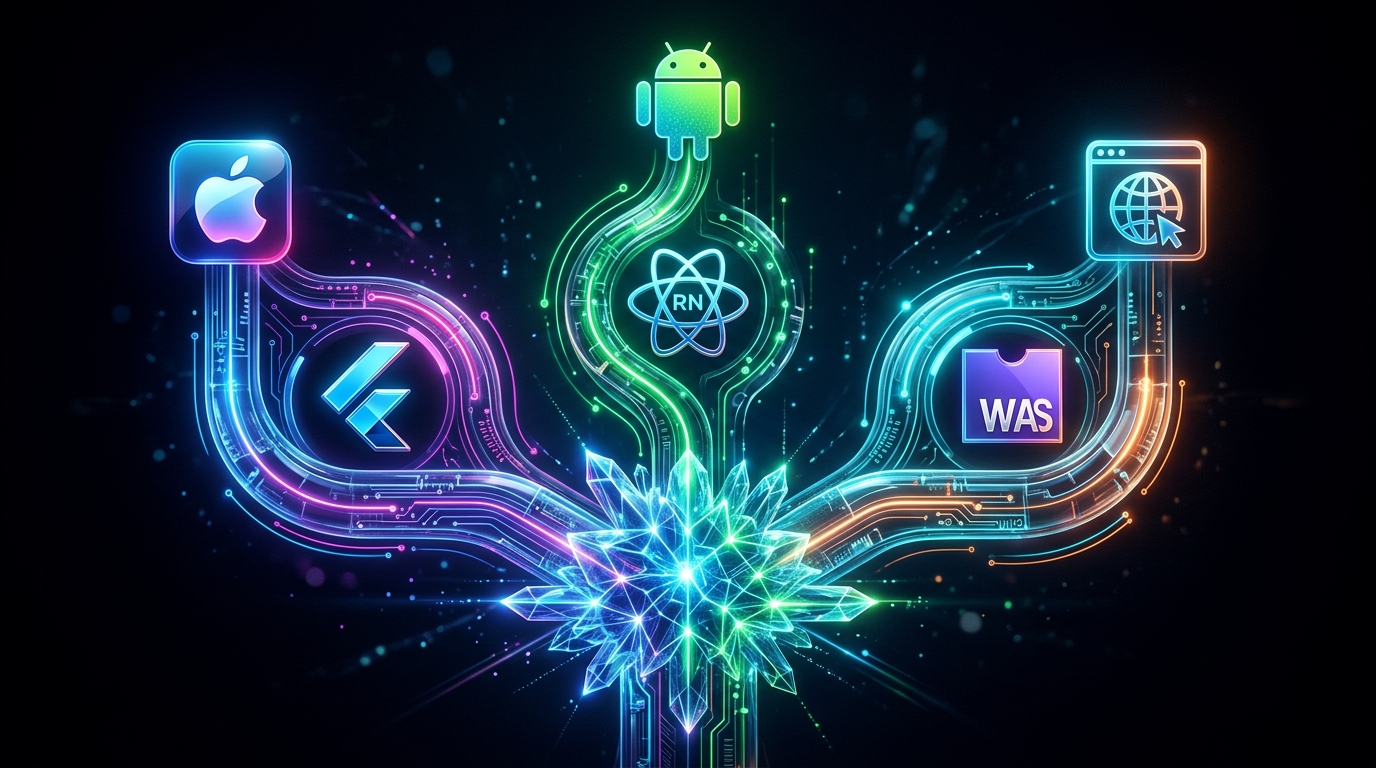
Google's framework using the Dart language. Brings its own rendering engine, so the UI is pixel-perfect and consistent across iOS, Android, web, macOS, Windows, and Linux. Best performance for UI-heavy apps. Single codebase for all platforms. Growing package ecosystem.
Best for: Teams starting fresh, apps with complex custom UI, projects that need web and mobile from one codebase.
React Native
Meta's framework using JavaScript/TypeScript and React. Bridges to native UI components on each platform. Massive npm ecosystem. Excellent for teams that already know React. New Architecture (stable since 2024) significantly improved performance.
Best for: Teams with existing React/JavaScript skills, apps that need to feel native to iOS and Android, projects that share logic with a React web app.
Flutter WASM (for web)
Flutter compiled to WebAssembly for web deployment. Produces near-native performance in the browser from the same Flutter codebase used for mobile. Best for web apps that are application-like (dashboards, tools, productivity apps) rather than content sites.
Best for: Flutter mobile projects that also need a web app, performance-critical web application UIs.
What "Write Once, Run Everywhere" Actually Means in Practice
The promise is real but requires nuance. With Flutter, approximately 80–90% of your code is shared across platforms. The remaining 10–20% handles platform-specific behaviour: camera access, push notification setup, deep linking, platform-specific UI conventions. This code is either written once using a plugin (most cases) or requires platform-specific implementation (rare cases for cutting-edge OS features).
Performance in 2026: Is It Good Enough?
For the vast majority of business applications: yes, definitively. Flutter apps built with the Impeller renderer and React Native apps using the New Architecture both deliver 60fps animations and sub-100ms response times for typical UI interactions. The cases where you still need native are genuinely narrow: real-time graphics processing, complex AR features, deep integration with very new platform APIs that plugins have not yet covered.
Cost Comparison
Building natively for iOS and Android: roughly 2x the development cost and ongoing maintenance cost of a cross-platform build.
Adding web to a Flutter mobile app: 20–30% additional cost (mostly handling web-specific layout differences and platform API substitutions). Compare this to building a separate web app, which effectively doubles the project.
Making the Decision
The right framework for your project depends on three factors: your team's existing skills, the platforms you need to support, and whether you have specific technical requirements that favour one approach.
If you are starting with no team preference: Flutter is the stronger default in 2026 for its true multi-platform story (including web and desktop) and performance headroom. If your team knows React: React Native delivers the productivity advantage of existing skills, which outweighs marginal technical differences in most projects.
Power Digital has built cross-platform apps in Flutter and React Native for clients in Singapore, Australia, and Southeast Asia. Talk to us about your app project →